Welcome, Class 7 scholars! As you advance in your study of English grammar, a nuanced understanding of Noun Gender becomes increasingly important. It's not just about identifying 'he' or 'she' words; it's about grammatical precision, correct pronoun agreement, and appreciating the subtleties of the English language. This chapter will equip you with a thorough understanding of noun gender, aligned with the NCERT and CBSE syllabus.
Lesson Plan on Noun Gender for Class 7
- Revisiting Noun Gender: A Grammatical Perspective
- The Four Fundamental Types of Noun Gender
- Advanced Methods of Forming Feminine Nouns
- Gender of Personified Nouns
- Gender of Abstract and Collective Nouns
- Key Takeaways for Mastery
- Exercises on Noun Gender for Class 7
- Quizzes on Noun Gender for Class 7
- FAQs on Noun Gender for Class 7
- Worksheet Ideas on Noun Gender for Class 7
Nouns: Gender for Class 7 | 4 Types & Advanced Concepts
Revisiting Noun Gender: A Grammatical Perspective
In English grammar, Gender is a system of classifying nouns that primarily reflects biological sex (male or female) but also extends to non-living entities and abstract concepts. This classification dictates the choice of pronouns (e.g., he, she, it, they) and possessive determiners (e.g., his, her, its, their) used in relation to the noun.
Consider these refined examples:
- The term benefactor (one who gives help, especially financial) refers to a male, thus it is Masculine.
- The term benefactress refers to a female equivalent, making it Feminine.
- The concept of justice, an abstract idea, is Neuter.
- The role chairperson can be filled by a male or female, hence it is Common.
A strong grasp of noun gender enhances clarity, precision, and sophistication in both written and spoken English.
The Four Fundamental Types of Noun Gender
Nouns in English are systematically categorized into four genders, each with specific characteristics and applications:
1. What is Masculine Gender? (Entities identified as Male)
Nouns that denote male individuals (persons or animals) are classified under the Masculine Gender.
Examples:
- Persons: emperor, duke, testator, proprietor, monk, stallion-owner, headmaster
- Animals: stag (male deer), drake (male duck), gander (male goose), bullock, ram, drone (male bee)
Associated pronouns: he, him, his.
Example Sentence: The proprietor discussed his expansion plans with the investors.
2. What is Feminine Gender? (Entities identified as Female)
Nouns that denote female individuals (persons or animals) belong to the Feminine Gender.
Examples:
- Persons: empress, duchess, testatrix, proprietress, nun, mare-owner, headmistress
- Animals: hind/doe (female deer), duck (female drake), goose (female gander), heifer, ewe, queen bee
Associated pronouns: she, her, hers.
Example Sentence: The headmistress addressed the assembly; her speech was truly inspiring.
3. What is Neuter Gender? (Lifeless Objects, Abstract Ideas, and some Lower Animals)
Nouns that denote inanimate objects, abstract concepts, or entities without a specified sex (like lower animals or young children where sex is irrelevant) are of the Neuter Gender. 'Neuter' signifies 'neither masculine nor feminine'.
Examples:
- Objects: manuscript, constitution, algorithm, skyscraper, satellite
- Abstract Nouns: integrity, philosophy, democracy, patriotism, wisdom, childhood
- Collective Nouns (as a unit): judiciary, committee, fleet, constellation
- Lower Animals/Young Children (sex unspecified): The ant carried its load. The infant cried for its mother.
Associated pronoun: it, its.
Example Sentence: The ancient manuscript revealed its secrets only after careful study.
4. What is Common Gender? (Entities applicable to Both Male and Female)
Nouns that can refer to either a male or a female are designated as Common Gender. These often denote professions, roles, or general categories of people.
Examples:
- Professions/Roles: legislator, engineer, researcher, astronaut, diplomat, curator, consultant
- General: sovereign, predecessor, denizen, acquaintance, beneficiary, infant, juvenile
- Animals (general term): predator, mammal, amphibian
Associated pronouns: Traditionally he or she, his or her. In contemporary English, singular they, them, their is widely accepted for inclusivity and when gender is unknown or irrelevant. Pluralizing the noun is another strategy.
Example Sentence: Each delegate must present their credentials upon arrival. / The researcher published his or her findings. / All researchers published their findings.
Advanced Methods of Forming Feminine Nouns
The transformation of masculine nouns to their feminine counterparts involves several established patterns, some of which are quite nuanced:
A. By Adding '-ess' (with variations)
This is a prevalent method, sometimes involving slight modifications to the masculine base.
| Masculine | Feminine | Note |
|---|---|---|
| patron | patroness | Direct addition |
| prophet | prophetess | Direct addition |
| heir | heiress | Direct addition (h is silent) |
| steward | stewardess | Direct addition |
| viscount | viscountess | Direct addition |
B. By Significant Modification Before Adding '-ess' or Suffix
The terminal part of the masculine form often undergoes alteration before the '-ess' suffix is appended, or a different suffix might be used.
| Masculine | Feminine | Note |
|---|---|---|
| abbot | abbess | 'ot' dropped |
| emperor | empress | 'or' changed to 'r' |
| governor | governess | 'or' dropped |
| murderer | murderess | 'er' dropped |
| sorcerer | sorceress | 'er' dropped |
| marquis (or marquess) | marchioness | Significant change |
| master | mistress | 'a' to 'i', 'er' to 'ress' |
| duke | duchess | 'k' to 'ch' |
C. By Altering a Key Word in a Compound Noun
In compound nouns, the gender distinction is typically made by changing the gender-specific component (often the first or second element).
| Masculine | Feminine |
|---|---|
| landlord | landlady |
| peacock | peahen |
| he-goat | she-goat |
| manservant | maidservant |
| step-father | step-mother |
| brother-in-law | sister-in-law |
| milkman | milkmaid / milkwoman |
| headmaster | headmistress |
D. By Employing Distinctly Different Lexical Items (Irregular Forms)
A significant number of common nouns utilize entirely separate words for their masculine and feminine forms, reflecting historical linguistic development.
| Masculine | Feminine |
|---|---|
| bachelor | spinster (dated) / bachelorette |
| boar (wild pig) | sow |
| buck (deer, rabbit) | doe |
| bullock / steer | heifer (young cow) |
| colt (young male horse) | filly (young female horse) |
| friar / monk | nun |
| gander | goose |
| hart (male deer) | roe (female deer) |
| sire (father animal) | dam (mother animal) |
| stallion | mare |
| wizard | witch / sorceress |
| ram (male sheep) | ewe (female sheep) |
| widower | widow |
E. Borrowed Gender Forms (From other languages)
English has also adopted gendered nouns from other languages, retaining their original feminine markers.
| Masculine | Feminine | Origin |
|---|---|---|
| administrator | administratrix | Latin |
| testator | testatrix | Latin |
| prosecutor | prosecutrix | Latin |
| sultan | sultana | Arabic/Turkish |
| signor (Italian) | signora | Italian |
| hero | heroine | Greek via Latin/French |
| czar / tsar | czarina / tsarina | Russian |
Gender of Personified Nouns
Personification is a literary device where inanimate objects or abstract ideas are endowed with human qualities or characteristics. When this occurs, these neuter nouns are often assigned a gender, typically masculine or feminine, to enhance imagery or convey specific attributes.
- Objects personified for strength, power, or violence are often treated as Masculine.
- Example: The Sun cast his golden rays.
- Example: Death lays his icy hand on kings.
- Example: Old Time, the clock-setter, that bald sexton, Time. (Shakespeare)
- Objects personified for beauty, grace, gentleness, or fertility are often treated as Feminine.
- Example: The Moon has hidden her face behind a cloud.
- Example: Sweet Peace, where dost thou chiefly haunt thy seat?
- Example: Fair Nature offers her bounty to all.
- Example: A ship is often referred to as 'she': "The Titanic met her tragic end."
- Example: Countries are sometimes referred to as 'she' when implying a motherland: "India is proud of her diverse culture."
It's important to note that this is a stylistic choice, primarily in literature and poetry, and does not change the grammatical neuter gender of these nouns in ordinary usage.
Gender of Abstract and Collective Nouns
Abstract Nouns (naming qualities, actions, states, ideas, e.g., honesty, bravery, childhood, judgment) are always considered Neuter Gender. They are referred to by the pronoun 'it'.
- Example: Truth always prevails in the end, doesn't it?
- Example: Happiness is a state of mind; it can be cultivated.
Collective Nouns (naming a group or collection of persons or things, e.g., jury, committee, army, fleet, crowd) are generally considered Neuter Gender when the group is thought of as a single, impersonal unit. They take a singular verb and the pronoun 'it'.
- Example: The committee has submitted its report.
- Example: The fleet set sail; it was a magnificent sight.
However, if the collective noun implies the individual members of the group acting separately or having different opinions, it can sometimes be treated as plural (Noun of Multitude) and take a plural verb and the pronoun 'they'. In such cases, it's not strictly a gender issue but one of number agreement.
- Example: The jury were divided in their opinions.
Key Takeaways for Mastery
- Masculine Gender: Refers to males. Pronoun: he. (e.g., emperor, stag, testator)
- Feminine Gender: Refers to females. Pronoun: she. (e.g., empress, doe, testatrix)
- Neuter Gender: Refers to inanimate objects, abstract nouns, collective nouns (as a unit), and lower animals/young children (sex unspecified). Pronoun: it. (e.g., constitution, integrity, committee)
- Common Gender: Refers to either male or female. Pronouns: he/she, they (singular). (e.g., sovereign, legislator, beneficiary)
- Feminine noun formation is diverse, including suffixes like '-ess', internal modifications, distinct words, and borrowed forms.
- Personification allows neuter nouns to be treated as masculine or feminine in literary contexts for stylistic effect.
- Abstract nouns are always neuter. Collective nouns are usually neuter when considered as a single unit.
Noun Gender Exercises for Class 7 with Answers
Exercise 1: Advanced Gender Identification
This exercise tests your ability to classify nouns based on their gender, including those with specific, common, or abstract meanings.
Identify the gender of the following nouns (Masculine, Feminine, Neuter, or Common).
- Beneficiary
- Sovereign
- Algorithm
- Administratrix
- Stag
- Patriotism
- Juvenile
- Heifer
- Constellation
- Curator
- Monk
- Duchess
- Infant
- Justice
- Gander
Exercise 2: Gender Transformation
This exercise tests your vocabulary and knowledge of gender pairs in English, including regular and irregular forms.
Provide the opposite gender for the given nouns.
- Masculine: Testator → Feminine: ________
- Feminine: Marchioness → Masculine: ________
- Masculine: Drone → Feminine: ________
- Feminine: Ewe → Masculine: ________
- Masculine: Proprietor → Feminine: ________
- Common: Spouse → Masculine: ________, Feminine: ________
- Masculine: Czar → Feminine: ________
- Feminine: Vixen → Masculine: ________
- Common: Aviator → Feminine (Archaic): ________
- Masculine: Bullock → Feminine: ________
- Feminine: Nun → Masculine: ________
- Masculine: Earl → Feminine: ________
- Common: Monarch → Masculine: ________, Feminine: ________
- Feminine: Goose → Masculine: ________
- Masculine: Sorcerer → Feminine: ________
Exercise 3: Gender in Context (Pronouns and Personification)
This exercise tests your understanding of pronoun agreement with noun gender and the literary use of personification.
Rewrite the sentences using the correct pronoun for the underlined noun or identify the gender being personified.
- The committee will present their findings tomorrow. (Use as a single unit)
- Justice, in her wisdom, ensures fairness for all. (Identify personified gender)
- Each legislator must cast his vote. (Use a gender-neutral pronoun)
- The old ship, battered by the storm, limped into port; he was a sorry sight. (Correct the personified gender)
- Integrity is a virtue; she is highly valued. (Correct the pronoun)
- The Sun cast her golden rays upon the field. (Correct the personified gender)
- The baby was crying because she was hungry. (Use a neutral pronoun)
- Death lays her icy hands on kings. (Identify personified gender)
- Every student should bring his or her book. (Use a more modern, singular pronoun)
- Nature always wears the colors of the spirit; he is beautiful. (Correct the pronoun and identify personification)
- The jury could not agree, so it gave individual opinions. (Correct the pronoun)
- The Moon has hidden his face behind a cloud. (Correct the personified gender)
- The dog wagged her tail happily. (Assume gender is unknown)
- Time, in his relentless march, waits for no one. (Identify personified gender)
- The nation showed their pride during the celebration. (Use as a single entity)
Noun Gender Quizzes for Class 7 (MCQ Online Test)
Quiz 1: Select the Correct Gender (MCQ)
Choose the most fitting gender classification for the given noun in standard English usage.
Choose the correct option.
- Adversary
- Sultana
- Philosophy
- Monastery
- Chairperson
- Wizard
- Orphan
- Tigress
- Rock
- Author
- Widower
- Happiness
- Dancer
- Lad
- Pen
Quiz 2: Advanced Gender Concepts (True or False)
Determine if the following statements regarding noun gender are True or False.
Choose the correct option.
- The noun 'heroine' is formed by adding '-ine' to the masculine noun 'hero'. (True / False)
- Abstract nouns like 'courage' are typically Common Gender. (True / False)
- In the sentence "The Sun shed his beams," 'Sun' is grammatically Masculine. (True / False)
- The word 'denizen' (an inhabitant) is always Masculine Gender. (True / False)
- The feminine of 'executor' is 'executrix'. (True / False)
- A 'stallion' is the feminine form of 'horse'. (True / False)
- The pronoun for a collective noun is always 'it'. (True / False)
- 'Spokesperson' is a common gender noun. (True / False)
- The feminine of 'fox' is 'foxess'. (True / False)
- The noun 'parent' is Common Gender. (True / False)
- All nouns ending in '-ess' are Feminine Gender. (True / False)
- In literature, the moon is often personified as feminine. (True / False)
- The opposite of 'nephew' is 'niece'. (True / False)
- The noun 'baby' is always considered Neuter Gender. (True / False)
- The word 'mankind' is now often replaced by the common gender term 'humankind'. (True / False)
Frequently Asked Questions (Advanced Queries for Class 7)
Q1: How does the historical evolution of English affect noun gender, particularly for professions?
Historically, many professions were predominantly male, leading to masculine terms (e.g., chairman, postman). As societal roles evolved, feminine forms (e.g., chairwoman) or, more recently, gender-neutral terms (e.g., chairperson, postal worker) emerged to reflect inclusivity. This linguistic shift mirrors societal changes and a move away from gender-binary assumptions in professional contexts.
Q2: Are there any "rules" for when to personify an inanimate object as masculine vs. feminine, or is it purely arbitrary?
While not strict rules, there are conventions. Objects personifying strength, power, or harshness (Sun, Death, War, Time, Winter) are often masculine. Those embodying beauty, grace, gentleness, fertility, or nurturing aspects (Moon, Earth, Nature, Spring, Liberty, Justice, ships, countries) are often feminine. However, these are tendencies influenced by mythology, cultural symbolism, and literary tradition, allowing for artistic license.
Q3: When using singular 'they' for a common gender noun, should the verb also be plural?
This is a point of ongoing discussion and stylistic variation. When singular 'they' refers to a specific, known individual who uses 'they/them' pronouns, the verb is typically plural (e.g., "Alex is here. They are happy to join us."). When singular 'they' is used generically for an unknown or unspecified person (e.g., "If a student needs help, they should ask."), the verb agreement can vary. Historically, some prescribed singular verbs ("they is/was"), but plural verb agreement ("they are/were") is now widely accepted and often preferred for consistency with plural 'they'. Style guides may offer specific recommendations.
Q4: Can the gender of a noun change over time or based on context, apart from personification?
Yes, the perceived or conventional gender association of some nouns can evolve. For instance, terms like 'author' or 'poet', once predominantly associated with men and having distinct feminine forms ('authoress', 'poetess'), are now largely treated as Common Gender. The context of use can also influence perception; for example, while 'dog' is generally common, if one is discussing breeding, 'dog' might specifically refer to a male in contrast to 'bitch' (female). However, fundamental grammatical gender (like 'book' being neuter) does not change.
Analytical Worksheet Tasks on Noun Gender (Class 7)
Engage with these analytical tasks to solidify your understanding of Noun Genders:
- Gender Transformation & Rule Identification: Given a list of masculine nouns (including some less common ones or those with foreign origins like 'czar', 'sultan'), students provide the feminine form and state the specific rule or pattern of formation (e.g., adding -ess, -ix, different word, changing compound element).
- Pronoun Agreement in Complex Sentences: Provide sentences featuring common gender nouns, collective nouns (used as singular and plural), and personified nouns. Students fill in the correct pronouns and possessive determiners, justifying their choices.
- Analyzing Gender in Literary Excerpts: Present short passages from literature or poetry. Students identify nouns, their grammatical gender, and instances of personification, explaining the effect of the personified gender.
- Debating Gendered Terminology: Research and present arguments for and against using gender-neutral terms versus traditional gendered terms (e.g., actor/actress, chairman/chairperson). Discuss the evolution of language.
- Creative Writing with Gender Focus: Write a short narrative or descriptive piece where students consciously use different types of noun gender, including personification, ensuring correct pronoun agreement throughout.
- Comparative Gender Study: Research how gender is expressed in another language (e.g., Hindi, French, German) and compare it with English noun gender system. (Advanced task)

Change the gender in sentences worksheet with answers pdf for Class 7
Fill in the blanks with the correct gender form of the noun described in brackets.

Change the gender in sentences worksheet for Class 7: Fill in the blanks with the correct gender form of the noun.

Worksheet on Gender for Class 7 with Answers
Read each noun below and write its gender next to it. Choose from: Masculine, Feminine, Neuter, Common.

Exercise on Gender for Class 7: Identify the Genders: Masculine, Feminine, Neuter, Common.

Nouns Gender Worksheet for Class 7 with Answers
Read each sentence carefully and underline all the nouns. After underlining the nouns in all the sentences, write each noun in the correct column in the table provided below.

Exercise on Noun Gender for Class 7: Identify and Sort Nouns: Masculine, Feminine, Neuter, Common.

Exercise on Noun Gender for Class 7 with Answers
Read the paragraph below carefully. Underline all the nouns in the paragraph. After underlining a noun, write its gender type.
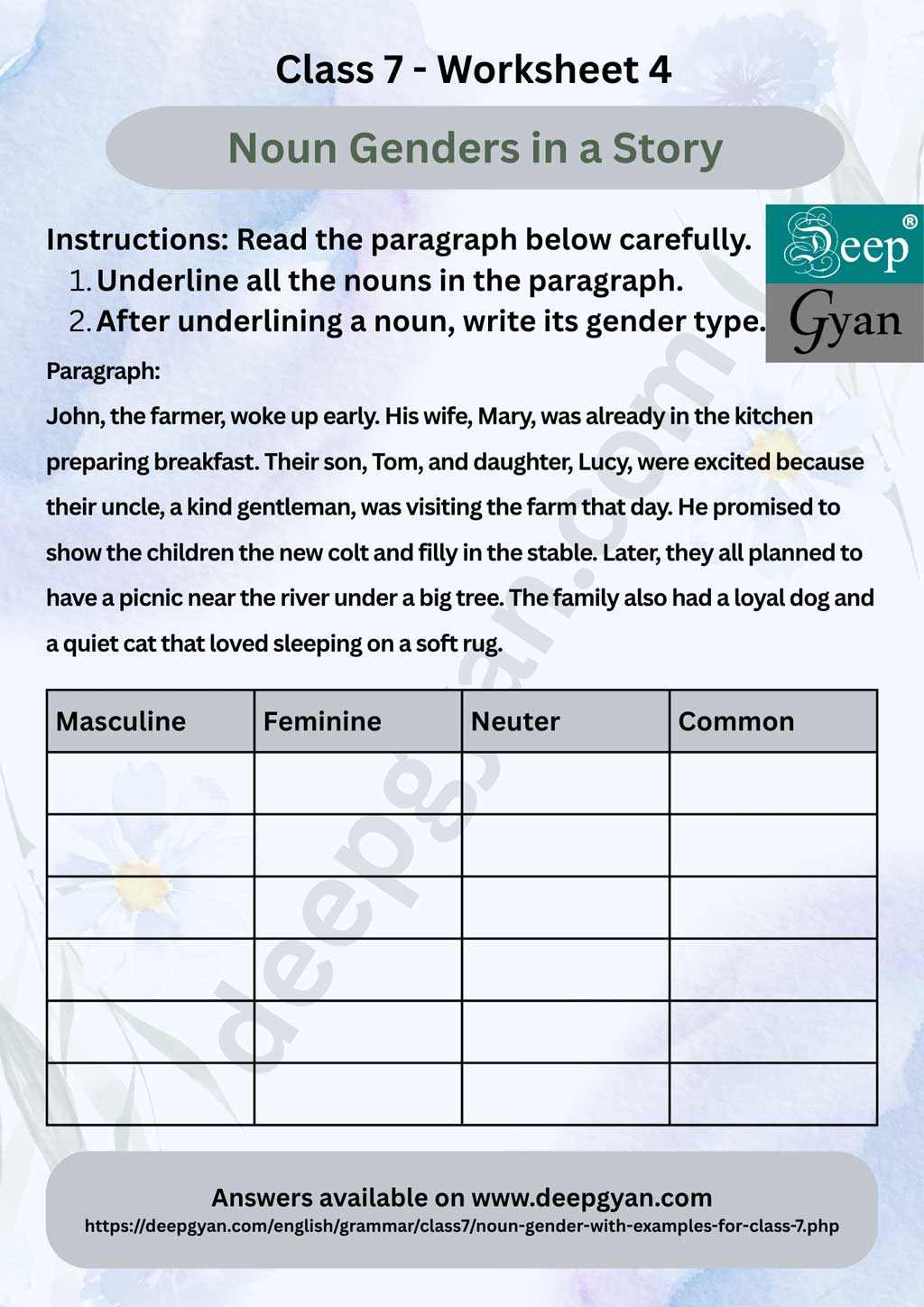
Worksheet on Noun Gender for Class 7: Identify and Sort Nouns: Masculine, Feminine, Neuter, Common.

Gender Exercise for Class 7 with Answers
Below is a list of nouns. Sort each noun into the correct column based on its gender: Masculine, Feminine, Neuter, or Common.

Gender Exercise for Class 7 with Answers: Sort the Nouns by Genders: Masculine, Feminine, Neuter, Common.

Gender Change Exercise for Class 7 with Answers
Read each noun below. Write its opposite gender in the blank space provided.
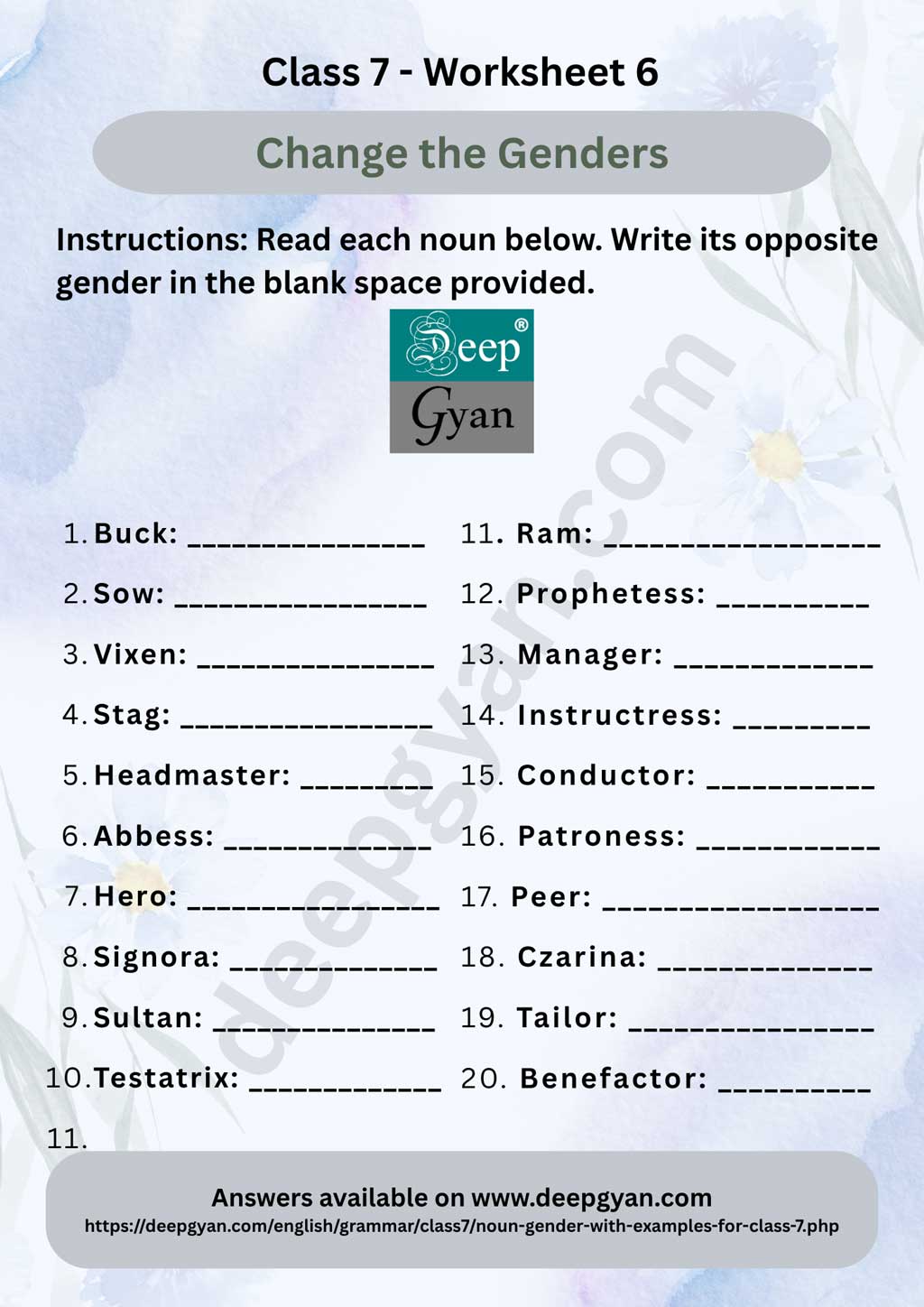
Gender Change Exercise for Class 7 with Answers: Write its opposite gender in the blank space provided.

Masculine and Feminine Gender Worksheets with Answers for Class 7 - Match the Gender
Match the masculine noun in Column A with its feminine noun in Column B by writing the correct letter from Column B in the blank.

Masculine and Feminine Gender Exercise for Class 7 with Answers: Match the Gender.

Change the Gender Worksheet with Answers PDF for Class 7 - Write the Opposite Gender
Write the opposite gender for each noun given below.

Change the Gender Exercise with Answers PDF for Class 7: Write the Opposite Gender.

Feminine and Masculine Gender Worksheet with Answers PDF for Class 7 - Fill in the Blanks
Fill in the blanks with the correct masculine or feminine noun.

Feminine and Masculine Gender Exercise with Answers PDF for Class 7: Fill in the blanks with the correct Gender.
About the Author: Anurag Jain
The Creator, Coder, and Educator behind Deepgyan.com
Qualified Company Secretary by education and teacher by heart, he is the sole force behind Deepgyan.com – the author, creator, developer, and promoter.
