Hello, Class 6 students! In our journey through English grammar, we encounter words that play very special roles. Today, we'll focus on Pronouns. These are incredibly useful words that act as substitutes for nouns (naming words). Using pronouns makes our sentences less repetitive and more fluent. Let's explore the different types of pronouns and how to use them correctly!
Our Pronoun Exploration Guide (Table of Contents)
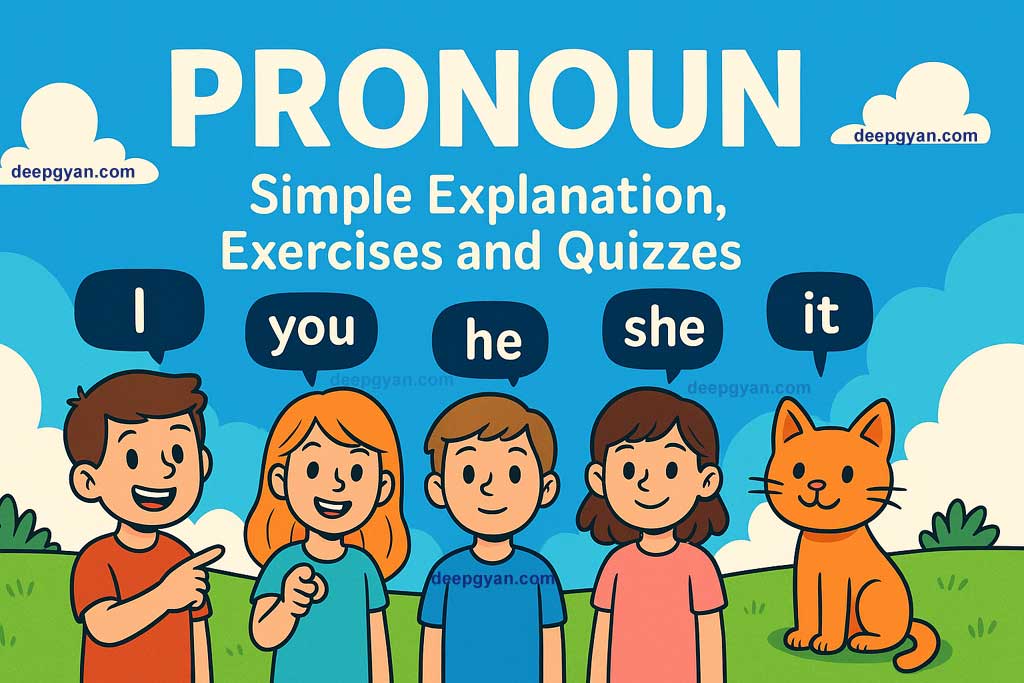
Pronouns for Class 6 | All Types & Examples
What are Pronouns? (The Noun Substitutes)
A Pronoun is a word that is used instead of a noun or a noun phrase. The word "pronoun" means "for a noun" (pro = for). Pronouns help us avoid repeating the same nouns over and over, making our language more varied and less cumbersome.
Consider this:
"Sarah loves to read. Sarah goes to the library every week. Sarah's favorite books are adventure stories."
Using pronouns, it becomes:
"Sarah loves to read. She goes to the library every week. Her favorite books are adventure stories."
The noun that a pronoun replaces is called its antecedent. In the example above, 'Sarah' is the antecedent of 'She' and 'Her'.
Exploring Different Types of Pronouns
There are several types of pronouns, each with a specific function. Let's learn about the main ones for Class 6.
1. Personal Pronouns (Subject and Object)
Personal Pronouns refer to specific persons or things. They change their form based on whether they are acting as the subject (doing the action) or the object (receiving the action) in a sentence.
Subject Pronouns: I, you, he, she, it, we, they.
Object Pronouns: me, you, him, her, it, us, them.
| Person | Singular Subject | Singular Object | Plural Subject | Plural Object |
|---|---|---|---|---|
| First Person (speaker) | I | me | we | us |
| Second Person (spoken to) | you | you | you | you |
| Third Person (spoken about) | he, she, it | him, her, it | they | them |
Examples:
- I am reading. (Subject) The teacher praised me. (Object)
- She baked a cake. (Subject) We invited her. (Object)
- They won the match. (Subject) The coach congratulated them. (Object)
2. Possessive Pronouns and Possessive Adjectives
These show ownership or belonging.
Possessive Adjectives (also called possessive determiners) are used before a noun to show possession. They describe the noun.
Examples: my, your, his, her, its, our, their.
- This is my book.
- That is their house.
Possessive Pronouns also show possession, but they stand alone and replace the noun phrase (possessive adjective + noun).
Examples: mine, yours, his, hers, its (rarely used alone), ours, theirs.
- This book is mine. (mine = my book)
- That house is theirs. (theirs = their house)
- The blue car is his. (his = his car)
| Possessive Adjective (before noun) | Possessive Pronoun (stands alone) |
|---|---|
| my | mine |
| your | yours |
| his | his |
| her | hers |
| its | its (usually not used alone as possessive pronoun) |
| our | ours |
| their | theirs |
Important Note: Possessive pronouns (like yours, hers, ours, theirs, its) never use an apostrophe ('). Don't confuse 'its' (possessive) with 'it's' (it is/it has).
3. Reflexive and Emphatic Pronouns
These pronouns end in -self (singular) or -selves (plural).
Examples: myself, yourself, himself, herself, itself, ourselves, yourselves, themselves.
Reflexive Pronouns: Used when the subject and the object of a sentence are the same person or thing. The action of the verb "reflects back" onto the subject.
- I hurt myself. (Subject 'I' and object 'myself' are the same)
- She taught herself to play the guitar.
- They prepared the meal themselves.
Emphatic (or Emphasizing) Pronouns: Used to add emphasis to a noun or another pronoun. They are not essential to the meaning of the sentence and can be removed.
- The principal himself addressed the students. (Emphasizes 'principal')
- I myself saw the incident. (Emphasizes 'I')
- She completed the project herself. (Emphasizes 'she' did it alone)
The form is the same, but the function is different. If removing the -self/-selves word changes the basic meaning of the sentence, it's reflexive. If it just removes emphasis, it's emphatic.
4. Demonstrative Pronouns
Demonstrative Pronouns point to specific people or things.
Examples: this, that, these, those.
- This/These: Refer to things near the speaker.
- This is my favorite storybook. (singular, near)
- These are fresh apples. (plural, near)
- That/Those: Refer to things farther away from the speaker.
- That is a tall building. (singular, far)
- Those birds are flying high. (plural, far)
Note: When these words (this, that, these, those) are followed directly by a noun, they act as Demonstrative Adjectives (e.g., "This book is interesting."). When they stand alone representing a noun, they are Demonstrative Pronouns.
5. Interrogative Pronouns
Interrogative Pronouns are used to ask questions. The answer to the question is usually a noun.
Examples: who, whom, whose, which, what.
| Interrogative Pronoun | Used For | Example Question |
|---|---|---|
| who | Asking about a person (subject) | Who won the race? |
| whom | Asking about a person (object - more formal) | Whom did you invite? |
| whose | Asking about possession | Whose bicycle is this? |
| which | Asking about a choice between people or things | Which of these colors do you prefer? |
| what | Asking about things or actions | What is your name? What happened? |
Note: When 'whose', 'which', and 'what' are followed directly by a noun, they act as Interrogative Adjectives (e.g., "Whose book is this?").
Important: Pronoun Agreement (Matching with Nouns)
A pronoun must agree with the noun it replaces (its antecedent) in number (singular/plural) and gender (masculine/feminine/neuter).
- If the noun is singular and masculine (boy, man, Mr. Roy), use he, him, his.
- Example: Mr. Roy is here. He wants to meet you.
- If the noun is singular and feminine (girl, woman, Mrs. Sen), use she, her, hers.
- Example: The queen was kind. Everyone loved her.
- If the noun is singular and neuter (thing, animal - gender unknown), use it, its.
- Example: The book is interesting. It has many pictures.
- If the noun is plural (boys, girls, books, animals), use they, them, their, theirs.
- Example: The students are working hard. They will succeed.
Key Takeaways: All About Pronouns
- Pronouns replace nouns to avoid repetition.
- Personal Pronouns:
- Subject: I, you, he, she, it, we, they
- Object: me, you, him, her, it, us, them
- Possessive Adjectives (before nouns): my, your, his, her, its, our, their.
- Possessive Pronouns (stand alone): mine, yours, his, hers, its, ours, theirs.
- Reflexive/Emphatic Pronouns: end in -self or -selves (e.g., myself, themselves). Reflexive shows action back on subject; Emphatic adds emphasis.
- Demonstrative Pronouns: point out (this, that, these, those).
- Interrogative Pronouns: ask questions (who, whom, whose, which, what).
- Pronouns must agree with the noun they replace in number and gender.
Practice Arena: Exercises on Pronouns for Class 6
Exercise 1: Choose the Correct Personal Pronoun
Fill in the blanks with the correct subject or object personal pronoun.
- My name is Arjun. ________ am in Class 6. (I / Me)
- Rina is my sister. ________ is very talented. (She / Her)
- The teacher called Rohan and me. ________ praised ________. (She, us / Her, we)
- The dogs are playing. ________ look happy. (It / They)
- This book belongs to my brother. Can you give it to ________? (he / him)
- My parents are going to the market. ________ asked me to join ________. (They, them / Them, they)
Answers: 1. I, 2. She, 3. She, us, 4. They, 5. him, 6. They, them
Exercise 2: Possessive Adjectives vs. Possessive Pronouns
Fill in the blanks with the correct possessive adjective or possessive pronoun.
- This is (my/mine) pencil. That pencil is (my/mine) too.
- (Your/Yours) project is excellent. Is this notebook (your/yours)?
- The red car is (his/he). (His/He) car is very fast.
- That beautiful dress is (her/hers). (Her/Hers) dress has sequins.
- This is (our/ours) classroom. The responsibility to keep it clean is (our/ours).
- The house with the blue gate is (their/theirs). (Their/Theirs) garden is lovely.
Answers: 1. my, mine, 2. Your, yours, 3. his, His, 4. hers, Her, 5. our, ours, 6. theirs, Their
Exercise 3: Using Reflexive/Emphatic Pronouns
Fill in the blanks with a suitable reflexive or emphatic pronoun (myself, yourself, himself, herself, itself, ourselves, yourselves, themselves).
- I completed the assignment all by ____________.
- The cat cleaned ____________ after its meal.
- She looked at ____________ in the mirror.
- The Prime Minister ____________ will address the nation.
- We should learn to help ____________.
- John, did you paint this picture ____________?
- The players motivated ____________ before the final match.
Answers: 1. myself, 2. itself, 3. herself, 4. himself, 5. ourselves, 6. yourself, 7. themselves
Exercise 4: Demonstrative and Interrogative Pronouns
Fill in the blanks with a suitable demonstrative (this, that, these, those) or interrogative pronoun (who, whom, whose, which, what).
- ____________ is the book I was looking for! (near)
- ____________ are the mountains I saw from the train. (far)
- ____________ is knocking at the door?
- ____________ of these dresses do you like more?
- ____________ did you give the message to?
- To ____________ does this pen belong? (formal) / ____________ pen is this?
- ____________ is the matter? Why are you upset?
- Are ____________ your shoes under the table? (near)
Answers: 1. This, 2. Those, 3. Who, 4. Which, 5. Whom/Who, 6. Whom / Whose, 7. What, 8. These
Test Your Knowledge: Quizzes on Pronouns for Class 6
Let's check your pronoun power!
Quiz 1: Identify the Pronoun Type
Choose the correct type for the underlined pronoun.
- She is an excellent orator.
(a) Possessive (b) Personal (Subject) (c) Reflexive - The decision is yours.
(a) Possessive Adjective (b) Personal (Object) (c) Possessive Pronoun - Who discovered penicillin?
(a) Demonstrative (b) Interrogative (c) Relative - The students prepared the charts themselves.
(a) Reflexive (b) Emphatic (c) Personal - That is an interesting hypothesis.
(a) Demonstrative (b) Personal (c) Possessive
Answers Quiz 1: 1. (b), 2. (c), 3. (b), 4. (b) (could be reflexive if they prepared it for themselves, but emphatic if just emphasizing they did it), 5. (a)
Quiz 2: True or False - Pronoun Facts!
Read these statements about pronouns. Are they True or False?
- "Me" is a subject pronoun. (True / False)
- "Her" can be a possessive adjective or an object pronoun. (True / False)
- Reflexive pronouns are used to ask questions. (True / False)
- "These" points to things that are far away. (True / False)
- A pronoun must always agree with its antecedent in gender and number. (True / False)
Answers Quiz 2: 1. False, 2. True, 3. False, 4. False, 5. True
Common Questions Answered (FAQs for Class 6)
Q1: What is the difference between "who" and "whom"?
Who is used as a subject pronoun (like he, she, they). Example: Who is coming to the party? (Answer could be: He is coming.)
Whom is used as an object pronoun (like him, her, them). Example: Whom did you see? (Answer could be: I saw him.)
In informal English, 'who' is often used even when 'whom' is grammatically correct. A simple trick: if you can replace it with 'he/she', use 'who'. If you can replace it with 'him/her', use 'whom'.
Q2: How do I know if a pronoun like 'himself' is reflexive or emphatic?
Try removing the '-self/-selves' pronoun from the sentence.
- If the sentence still makes sense but loses some emphasis, it was an emphatic pronoun. Example: "The captain himself led the team." (Removing 'himself': "The captain led the team." - makes sense, just less emphasis).
- If the sentence no longer makes sense or its meaning changes completely, it was a reflexive pronoun because the action was directed back to the subject. Example: "He blamed himself for the mistake." (Removing 'himself': "He blamed for the mistake." - doesn't make sense).
Q3: Is "its" the same as "it's"?
No, they are different!
- Its (no apostrophe) is a possessive adjective or possessive pronoun showing belonging. Example: "The dog wagged its tail."
- It's (with an apostrophe) is a contraction (short form) for "it is" or "it has". Example: "It's a sunny day." (It is a sunny day). "It's been a long journey." (It has been a long journey).
Creative Practice: Worksheet on Pronouns for Class 6
Here are some engaging worksheet ideas for practicing Pronouns:
- Pronoun Detective: Provide a short story or paragraph. Students identify all the pronouns and list them under their types (Personal-Subject, Personal-Object, Possessive Adjective, Possessive Pronoun, Reflexive, etc.).
- Antecedent Hunt: Give sentences with pronouns. Students identify the pronoun and then find and write its antecedent (the noun it replaces).
- "Who Owns What?" Table: Create a table with columns for "Owner (Noun)", "Thing Owned", "Sentence with Possessive Adjective", and "Sentence with Possessive Pronoun". Students fill it out.
- Reflexive vs. Emphatic Sort: Provide sentences with -self/-selves pronouns. Students decide if each is used reflexively or emphatically and explain why.
- Dialogue Creation: Give a scenario (e.g., two friends planning a trip). Students write a short dialogue using a variety of personal, possessive, and interrogative pronouns.
- Sentence Combining with Pronouns: Give pairs of sentences that can be improved by using pronouns to avoid repetition. Students rewrite them. (e.g., "The students worked hard. The students got good grades." → "The students worked hard. They got good grades.")
- Demonstrative Storyboard: Students create a simple storyboard (3-4 panels) and write captions for each panel using 'this', 'that', 'these', 'those' appropriately to point out objects in their drawings.
About the Author: Anurag Jain
The Creator, Coder, and Educator behind Deepgyan.com
Qualified Company Secretary by education and teacher by heart, he is the sole force behind Deepgyan.com – the author, creator, developer, and promoter.
