In English grammar, nouns are often classified by Gender. Two of the primary classifications are Masculine Gender (referring to males) and Feminine Gender (referring to females). Understanding these genders is key to using correct pronouns (like he/she, him/her, his/hers) and building accurate, clear sentences. This guide will explore the definitions of masculine and feminine gender nouns, provide numerous examples, discuss how feminine nouns are formed, and offer practice exercises and quizzes. This content is suitable for learners from Classes 1 to 10, aligning with NCERT and CBSE guidelines.

Masculine and Feminine Gender: Definition, Examples, Usage, Exercises, PDF Worksheet (Class 1-10 NCERT/CBSE)
Your Guide to Masculine & Feminine Gender Nouns (Table of Contents)
- What is Gender in Nouns? (Brief Overview)
- Understanding Masculine Gender
- Understanding Feminine Gender
- Ways of Forming Feminine Nouns from Masculine Nouns
- Other Genders: Common and Neuter (Brief Mention)
- Summary Table of Masculine & Feminine Gender
- Practice Arena: Worksheets on Masculine & Feminine Gender
- Test Your Knowledge: Quizzes on Masculine & Feminine Gender
- Downloadable PDF Worksheet
- Common Questions Answered (FAQs)
- Creative Practice: Worksheet Ideas
- Downloadable Masculine & Feminine Gender Worksheets (Images)
What is Gender in Nouns? (Brief Overview)
In English grammar, Gender is a way of classifying nouns based on whether they refer to males, females, either sex, or things without a biological sex. The four main types are Masculine, Feminine, Common, and Neuter. This guide will focus primarily on Masculine and Feminine genders.
Understanding noun gender is crucial for using correct pronouns and forming grammatically sound sentences.
Understanding Masculine Gender
Definition and Basic Idea
A noun that denotes a male person or animal is said to be of the Masculine Gender.
Basic Idea: These are words for boys, men, and male animals.
Examples: father, king, actor, lion, rooster.
Identifying Masculine Gender Nouns
To identify a masculine gender noun, ask: "Does this word specifically refer to a male?"
- Nouns for male family members: son, brother, uncle, grandfather.
- Nouns for male roles or titles: prince, emperor, waiter, hero.
- Nouns for male animals: bull, stallion, gander, drake.
Examples of Masculine Gender Nouns
A. Examples of Male Persons Nouns
| Masculine Noun | Example Sentence |
|---|---|
| man | The man is reading a book. |
| boy | A boy is playing in the park. |
| husband | Her husband is a pilot. |
| nephew | My nephew is very clever. |
| wizard | The old wizard cast a spell. |
| policeman | The policeman directed the traffic. |
| landlord | The landlord collected the rent. |
| bridegroom | The bridegroom looked happy. |
B. Examples of Male Animals Nouns
| Masculine Noun | Example Sentence |
|---|---|
| lion | The lion roared majestically. |
| tiger | A male tiger has distinctive stripes. |
| ram | The ram had large, curling horns. |
| peacock | The peacock displayed its beautiful feathers. |
| fox (male) / dog fox | The dog fox was cunning. |
| boar | A wild boar roamed the woods. |
| buck | The hunter spotted a buck. |
| drone | A drone is a male bee. |
Masculine Gender and Pronouns (He, Him, His)
When referring to masculine nouns, we use masculine pronouns:
- Subject: He (John is smart. He studies hard.)
- Object: Him (I saw Paul. I gave the book to him.)
- Possessive: His (That is Tom's bag. It is his bag. / The bag is his.)
- Reflexive: Himself (The boy taught himself to play guitar.)
Understanding Feminine Gender
Definition and Basic Idea
A noun that denotes a female person or animal is said to be of the Feminine Gender.
Basic Idea: These are words for girls, women, and female animals.
Examples: mother, queen, actress, lioness, hen.
Identifying Feminine Gender Nouns
To identify a feminine gender noun, ask: "Does this word specifically refer to a female?"
- Nouns for female family members: daughter, sister, aunt, grandmother.
- Nouns for female roles or titles: princess, empress, waitress, heroine.
- Nouns for female animals: cow, mare, ewe, vixen.
Examples of Feminine Gender Nouns
A. Examples of Female Persons Nouns
| Feminine Noun | Example Sentence |
|---|---|
| woman | The woman is a successful entrepreneur. |
| girl | A girl was singing a sweet song. |
| wife | His wife is a talented artist. |
| niece | My niece loves to dance. |
| witch | The story featured a kind witch. |
| policewoman | The policewoman helped the lost child. |
| landlady | The landlady was very understanding. |
| bride | The bride looked beautiful in her gown. |
B. Examples of Female Animals Nouns
| Feminine Noun | Example Sentence |
|---|---|
| lioness | The lioness protected her cubs. |
| tigress | The tigress moved silently through the jungle. |
| ewe | The shepherd cared for the ewe and her lamb. |
| peahen | The peahen is less colorful than the peacock. |
| vixen | The vixen (female fox) was very alert. |
| sow | The sow had many piglets. |
| doe | A graceful doe grazed peacefully. |
| queen bee | The queen bee is essential to the hive. |
Feminine Gender and Pronouns (She, Her, Hers)
When referring to feminine nouns, we use feminine pronouns:
- Subject: She (Mary is here. She looks happy.)
- Object: Her (I met Susan. I gave the flowers to her.)
- Possessive: Her (determiner), Hers (independent) (That is Jane's dress. It is her dress. / The dress is hers.)
- Reflexive: Herself (The girl dressed herself.)
Ways of Forming Feminine Nouns from Masculine Nouns
There are three main ways to form the feminine gender of nouns:
1. By Using an Entirely Different Word
Some masculine nouns have completely different words for their feminine counterparts.
| Masculine | Feminine | Example (Feminine) |
|---|---|---|
| father | mother | Her mother is a teacher. |
| brother | sister | My sister is younger than me. |
| king | queen | The queen waved to the people. |
| monk | nun | A nun lives in a convent. |
| horse/stallion | mare | The farmer owns a gentle mare. |
| bull | cow | The cow grazed in the pasture. |
| rooster | hen | The hen laid an egg. |
| wizard | witch | The good witch helped the children. |
| sir | madam | "Good morning, Madam," he replied. |
| bachelor | spinster (or single woman) | She chose to remain a spinster. |
| drake | duck | A duck and her ducklings swam by. |
2. By Adding a Suffix (e.g., -ess, -ine, -trix, -a)
Many feminine nouns are formed by adding a suffix to the masculine form. The most common suffix is -ess.
| Masculine | Feminine | Example (Feminine) |
|---|---|---|
| actor | actress | The actress won an award. |
| prince | princess | The princess wore a beautiful gown. |
| lion | lioness | The lioness is a fierce hunter. |
| tiger | tigress | A tigress cares for her cubs. |
| waiter | waitress | The waitress served our table. |
| host | hostess | The hostess greeted the guests. |
| heir | heiress | She is the heiress to a large fortune. |
| poet | poetess (though 'poet' is often used for both) | The poetess read her poems. |
| hero | heroine | She is the heroine of the story. |
| executor | executrix | The will named her as the executrix. |
| sultan | sultana | The sultana ruled wisely. |
| baron | baroness | The Baroness von Trapp was famous. |
| shepherd | shepherdess | The shepherdess tended her flock. |
| emperor | empress | The empress was very powerful. |
Note: Some -ess forms like 'authoress' are becoming less common, with the masculine form ('author') often used for both genders.
3. By Changing Part of a Compound Word (or adding a gender-specific word)
For compound nouns, the gender is often indicated by changing one part of the word or by adding a gender-specific word before or after.
| Masculine/Common | Feminine | Example (Feminine) |
|---|---|---|
| grandfather | grandmother | My grandmother bakes cookies. |
| landlord | landlady | The landlady collected the rent. |
| milkman | milkmaid / milkwoman | The milkmaid delivered milk. |
| peacock | peahen | The peahen is less colorful. |
| manservant | maidservant | The maidservant cleaned the house. |
| salesman | saleswoman / saleslady | The saleswoman was very helpful. |
| he-goat | she-goat | The she-goat had two kids. |
| billy-goat | nanny-goat | The nanny-goat is in the field. |
| chairman | chairwoman / chairperson | The chairwoman led the meeting. |
| policeman | policewoman | A policewoman helped us. |
Other Genders: Common and Neuter (Brief Mention)
While this guide focuses on Masculine and Feminine genders, it's good to remember the other two:
- Common Gender: Nouns that can refer to either a male or a female (e.g., student, teacher, child, doctor, artist).
- Neuter Gender: Nouns that refer to non-living things or objects that have no biological sex (e.g., book, table, computer, idea, city).
Summary Table of Masculine & Feminine Gender
| Feature | Masculine Gender | Feminine Gender |
|---|---|---|
| Refers to | Male persons or animals | Female persons or animals |
| Examples (Persons) | man, boy, king, actor, father | woman, girl, queen, actress, mother |
| Examples (Animals) | lion, rooster, stallion, bull | lioness, hen, mare, cow |
| Pronouns | he, him, his | she, her, hers |
| Forming Feminine | (Masculine is base) | Different word, add suffix (-ess), change compound part |
Practice Arena: Worksheets on Masculine & Feminine Gender
Exercise 1: Identify the Gender
Identify whether the underlined noun is Masculine or Feminine.
- The prince will become king. (__________)
- My aunt is a kind woman. (__________)
- The rooster crows early in the morning. (__________)
- The heroine of the story was very brave. (__________)
- A waiter took their order. (__________)
- The mare galloped across the field. (__________)
- Her husband is a chef. (__________)
- The empress ruled with grace. (__________)
Exercise 2: Write the Opposite Gender
Write the noun of the opposite gender for each of the following.
- Masculine: uncle → Feminine: _______
- Feminine: actress → Masculine: _______
- Masculine: bull → Feminine: _______
- Feminine: queen → Masculine: _______
- Masculine: host → Feminine: _______
- Feminine: vixen → Masculine: _______
- Masculine: son → Feminine: _______
- Feminine: nun → Masculine: _______
- Masculine: widower → Feminine: _______
- Feminine: landlady → Masculine: _______
Exercise 3: Fill in the Blanks
Fill in the blanks with the correct masculine or feminine form of the noun in parentheses.
- The (king) _______ and his _______ (feminine of king) ruled wisely.
- My (brother) _______ has a son, who is my _______ (masculine of niece).
- The (lion) _______ and the _______ (feminine of lion) protect their cubs.
- The (waiter) _______ served the ladies, while a _______ (feminine of waiter) served the gentlemen.
- A (hero) _______ is admired, and so is a _______ (feminine of hero).
- The (bridegroom) _______ waited for his _______ (feminine of bridegroom) at the altar.
- The (shepherd) _______ watched his flock, and sometimes his _______ (feminine of shepherd) helped him.
Test Your Knowledge: Quizzes on Masculine & Feminine Gender
Quiz 1: Multiple Choice
Choose the best answer.
- Which of these is a Feminine Gender noun?
(a) father (b) gander (c) niece (d) table - The Masculine Gender of 'mare' is:
(a) horse (b) stallion (c) Both a and b (d) bull - 'He' is a pronoun used for:
(a) Feminine Gender (b) Masculine Gender (c) Neuter Gender (d) Common Gender - The Feminine Gender of 'duke' is:
(a) dukess (b) duchess (c) lady duke (d) dukene - Which pair is correctly matched for Masculine-Feminine?
(a) boy-woman (b) uncle-nephew (c) rooster-hen (d) lion-tigress - The feminine of 'baron' is:
(a) baroness (b) baronin (c) barona (d) lady baron
Quiz 2: True or False
Determine if the following statements are True or False.
- 'Princess' is a Masculine Gender noun. (True / False)
- The noun 'teacher' is Common Gender, not specifically Masculine or Feminine. (True / False)
- The feminine of 'fox' is 'foxess'. (True / False)
- 'She' and 'her' are pronouns used for Feminine Gender nouns. (True / False)
- All Feminine Gender nouns end with the suffix '-ess'. (True / False)
- 'Stallion' is the feminine form of 'horse'. (True / False)
Downloadable PDF Worksheet on Masculine & Feminine Gender
For comprehensive practice on identifying and forming nouns, download our specially designed PDF worksheet. It includes a variety of exercises, including matching, fill-in-the-blanks, and conversion tasks, suitable for Class 1, Class 2, Class 3, Class 4, Class 5, Class 6, Class 7 and Class 8. An answer link is included.
Download Worksheets on Noun (Mixed Exercises)
Download Worksheets on Animals and Birds Gender
Download Worksheets on Noun Gender
Download Worksheets on Feminine Gender
Download Worksheets on Masculine Gender
Download PDF of List of Masculine & Feminine Gender
Download PDF of Change the Gender in Sentences
Download PDF of Masculine and Feminine Genders Worksheets - Fill in the Blanks
Download PDF of Masculine and Feminine Genders Worksheets - Match the Pairs
Download PDF of Masculine and Feminine Genders Worksheets - Write the Opposite Genders
Common Questions About Masculine & Feminine Gender Nouns Answered (FAQs)
Q1: How do I know if a noun is Masculine or Feminine?
You can usually tell by its meaning. If it refers to a male person or animal, it's Masculine (e.g., man, lion). If it refers to a female person or animal, it's Feminine (e.g., woman, lioness). Some words have specific forms for each gender.
Q2: Are there rules for changing Masculine nouns to Feminine?
Yes, there are three main ways:
- Using a completely different word (e.g., boy → girl).
- Adding a suffix, most commonly '-ess' (e.g., actor → actress).
- Changing part of a compound word (e.g., landlord → landlady).
Q3: What about nouns like 'student' or 'doctor'? What gender are they?
Nouns like student, doctor, teacher, parent, child, artist are of Common Gender. This means they can refer to either a male or a female. We use context or other words (like 'male student' or 'female doctor') to specify if needed.
Q4: Do inanimate objects like 'table' or 'book' have Masculine or Feminine gender?
No, inanimate objects are generally of Neuter Gender. They are referred to using the pronoun 'it'. However, sometimes in literature (personification), objects like ships or countries are referred to as 'she', or powerful things like the sun as 'he'.
Q5: Is 'actor' only Masculine, or can it be used for females too?
Traditionally, 'actor' was Masculine and 'actress' was Feminine. However, it's now common and widely accepted to use 'actor' as a Common Gender noun, referring to both male and female performers. 'Actress' is still used but 'actor' for females is also correct and often preferred for inclusivity.
Creative Practice: Worksheet Ideas for Masculine & Feminine Gender
Adapt these ideas for different class levels:
- Gender Pairs (Basic): Match masculine nouns (e.g., king, bull) with their feminine counterparts (e.g., queen, cow).
- "He or She?" Sort (Basic/Intermediate): Provide a list of nouns; students sort them into Masculine and Feminine columns. Add a "Common" column for an extra challenge.
- Form the Feminine (Intermediate): Give masculine nouns and ask students to write the feminine form, applying different rules (e.g., prince → princess; hero → heroine).
- Sentence Rewrite (Intermediate): Rewrite sentences, changing the gender of the noun and the corresponding pronouns. (e.g., "The boy lost his ball." → "The girl lost her ball.")
- Character Creation (All Levels): Students create a male character and a female character for a story, listing their names (if gendered) and other gendered nouns associated with them.
- Opposite Gender Story (Advanced): Students write a short story and then rewrite it by changing the gender of the main characters and all related nouns/pronouns.
Downloadable Masculine & Feminine Gender Worksheets (Images)
Suitable for Grade 1, Grade 2, Grade 3, Grade 4, Grade 5, Grade 6, Grade 7 and Grade 8

Match the Gender Worksheet with Answers

Masculine and Feminine Genders Worksheet - Match the Pairs
Match the Masculine Gender with the Feminine Gender Worksheet

Masculine and Feminine Nouns: A Matching Exercise
Advanced Gender Nouns Matching Worksheet

Gender Pairs Matching Quiz - Advanced Vocabulary
Worksheet to Match the Female and Male Genders

English Grammar: Match the Female and Male
Match the Masculine Gender with the Feminine Gender (Sheet 5)

Gender Noun Pairs: A Matching Challenge
Downloadable Change the Gender in Sentences Worksheet with Answers (Images)
Suitable for Class 1, Class 2, Class 3, Class 4, Class 5, Class 6, Class 7 and Class 8

Gender Changing Nouns in Sentences Worksheet

English Exercise: Gender Forms in Sentences
Gender Noun Forms in Sentences

Grammar Challenge: Masculine and Feminine in Sentences
Worksheet on Gender Nouns, Including Common Gender

Grammar Practice: Masculine, Feminine & Common Gender
Change the Gender in Sentences Worksheet with Answers

English Grammar: Noun Genders in Context
Worksheet to Change the Gender of Nouns (with Answers)

Mastering Noun Genders: A Practice Sheet
Downloadable Opposite Gender Worksheet with Answers (Images)
Suitable for Class 1, Class 2, Class 3, Class 4, Class 5, Class 6, Class 7 and Class 8

Worksheet for Writing Opposite Gender Nouns

Practice Exercise: Identifying Opposite Genders
Advanced Opposite Gender Nouns Worksheet
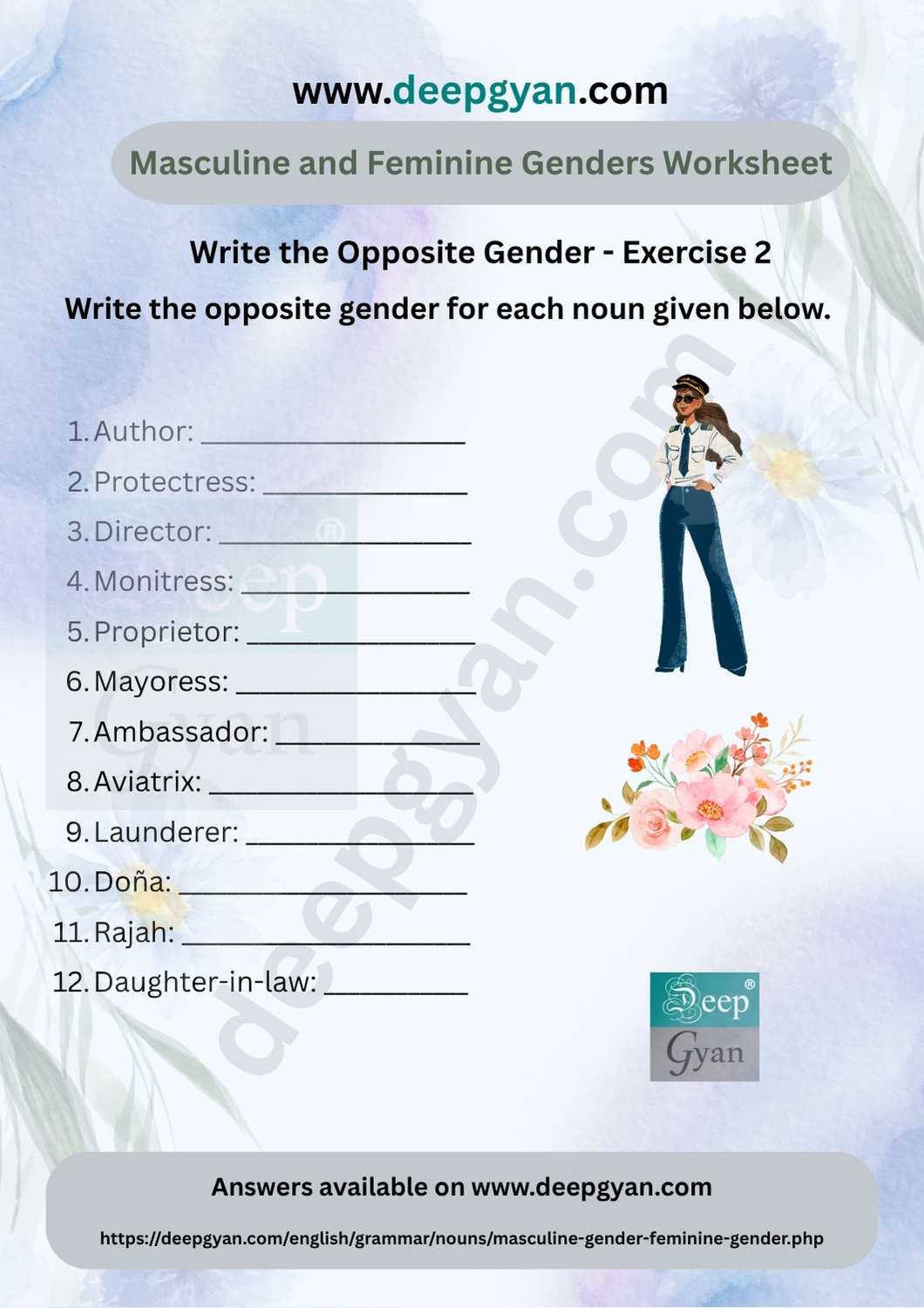
Vocabulary Building: Advanced Gender Nouns
Opposite Gender Practice for Job Titles and Roles

Grammar Quiz: Genders of Titles and Roles
Free Opposite Gender Worksheet

Vocabulary Quiz: Finding the Opposite Gender
Printable Opposite Gender Worksheet (Exercise 5)

English Quiz: Masculine and Feminine Nouns
Identify the Gender Worksheet with Answers (Images)
Suitable for Class 1, Class 2, Class 3, Class 4, Class 5, Class 6, Class 7 and Class 8

Gender Noun Definitions Worksheet (Fill in the Blanks)

English Vocabulary: Noun Genders by Definition

Identify the Gender Worksheet (Exercise 2)

Grammar Quiz: Identifying Nouns by Gender

Identify the Gender Noun Worksheet (Exercise 3)

Vocabulary Test: Naming Gender Nouns

Links of other related pages
Masculine and Feminine of Animals
Masculine and Feminine of Birds
Masculine and Feminine of Fish, Reptiles & Amphibians
100 Examples of Masculine and Feminine gender
Feminine of Nouns starting with 'A'
Feminine of Nouns starting with 'B'
Feminine of Nouns starting with 'C'
Feminine of Nouns starting with 'D'
Feminine of Nouns starting with 'E'
Feminine of Nouns starting with 'F'
Feminine of Nouns starting with 'G'
Feminine of Nouns starting with 'H'
Feminine of Nouns starting with 'I'
Feminine of Nouns starting with 'J'
Feminine of Nouns starting with 'K'
Feminine of Nouns starting with 'L'
Feminine of Nouns starting with 'M'
Feminine of Nouns starting with 'N'
Feminine of Nouns starting with 'O'
Feminine of Nouns starting with 'P'
Feminine of Nouns starting with 'Q'
Feminine of Nouns starting with 'R'
Feminine of Nouns starting with 'S'
Feminine of Nouns starting with 'T'
Feminine of Nouns starting with 'U'
Feminine of Nouns starting with 'V'
Feminine of Nouns starting with 'W'
Feminine of Nouns starting with 'X, Y, Z'
Masculine of Nouns starting with 'A'
Masculine of Nouns starting with 'B'
Masculine of Nouns starting with 'C'
Masculine of Nouns starting with 'D'
Masculine of Nouns starting with 'E'
Masculine of Nouns starting with 'F'
Masculine of Nouns starting with 'G'
Masculine of Nouns starting with 'H'
Masculine of Nouns starting with 'I'
Masculine of Nouns starting with 'J & K'
Masculine of Nouns starting with 'L'
Masculine of Nouns starting with 'M'
Masculine of Nouns starting with 'N'
Masculine of Nouns starting with 'O'
Masculine of Nouns starting with 'P'
Masculine of Nouns starting with 'Q & R'
Masculine of Nouns starting with 'S'
Masculine of Nouns starting with 'T'
Masculine of Nouns starting with 'U & V'