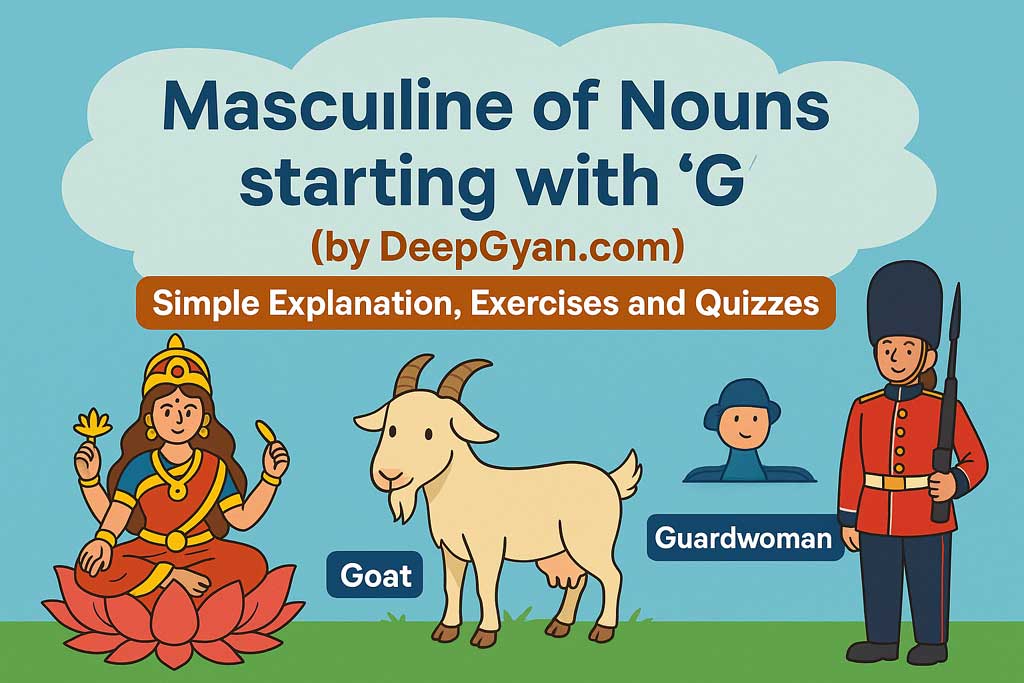
Masculine of Nouns starting with 'G'
Table of Content
Masculine of Nouns for People (Starting with 'G')
What is the Masculine of Gammer?
The masculine of Gammer is Gaffer.
Rule: These are archaic English terms for an old woman and an old man, respectively. They are rarely used today but may be found in historical texts or plays.
Definitions:
- A Gammer is an old woman.
- A Gaffer is an old man.
Examples:
- Old Gammer Grethel was known for telling the best fairy tales.
- The old gaffer sat by the fire, smoking his pipe.
What is the Masculine of Giantess?
The masculine of Giantess is Giant.
Rule: The feminine form is created by adding the "-ess" suffix to the masculine form.
Modern Usage: "Giant" is often used as a common gender noun today, but "Giantess" is still standard for a female giant in myths and stories.
Examples:
- The hero had to climb a beanstalk to defeat the fearsome giant.
- In the fantasy novel, the queen was a powerful giantess from the northern mountains.
What is the Masculine of Girl?
The masculine of Girl is Boy.
Rule: This is one of the most fundamental gender pairs in English, using completely different words for the feminine and masculine forms.
Definitions:
- Girl: A female child or young woman.
- Boy: A male child or young man.
Examples:
- Every boy and girl in the class received a prize.
- The little girl was flying a kite.
What is the Masculine of Goddess?
The masculine of Goddess is God.
Rule: The feminine form is created by adding the "-ess" suffix to the masculine form.
Definitions:
- Goddess: A female deity.
- God: A male deity.
Examples:
- Athena was the Greek goddess of wisdom.
- Zeus was the king of the Olympian gods.
What is the Masculine of Governess?
The masculine of Governess is Governor.
Important Note: While these are the traditional grammatical pairs, the meanings have diverged significantly in modern English.
Definitions:
- Governess: A woman employed to teach children in a private household. (Largely a historical role).
- Governor: The elected executive head of a state or a person in charge of an institution.
- The modern, neutral term for a private teacher is Tutor.
Examples:
- Jane Eyre worked as a governess in Mr. Rochester's home.
- The governor of the state held a press conference.
What is the Masculine of Grandmother?
The masculine of Grandmother is Grandfather.
Rule: The gender is indicated by the root word (mother/father).
Note: This also applies to Grand-dam (an old term for grandmother or female ancestor), whose masculine counterpart is Grandsire (an old term for grandfather or male ancestor).
Examples:
- My grandmother bakes the best cookies.
- My grandfather fought in the war.
What is the Masculine of Guardswoman?
The masculine of Guardswoman is Guardsman.
Modern Usage: The gender-neutral term is often simply Guard.
Definitions:
- Guardswoman: A female soldier in a guards regiment.
- Guardsman: A male soldier in a guards regiment.
- Guard: A person of any gender who keeps watch.
Examples:
- The guardsman stood perfectly still at his post outside the palace.
- She was proud to be the first guardswoman in her family.
Masculine of Nouns for Animals (Starting with 'G')
Masculine of Goat
The masculine of a female goat (a Nanny or Doe) is a Billy or Buck.
- Feminine: Nanny / Doe
- Masculine: Billy / Buck
Note: "Goat" is the common gender term for the species.
Example:
- The nanny goat protected her kids from danger.
- An old billy goat with a long beard stood on the hill.
Masculine of Goose
The masculine of a Goose (the female) is a Gander.
Rule: This pair uses completely different words for the male and female.
- Feminine: Goose (Plural: Geese)
- Masculine: Gander
Example:
- The mother goose hissed at anyone who came too close to her goslings.
- The large white gander led the flock of geese across the field.
Special Cases
Gender of Gander
The word Gander is a masculine noun. Its feminine counterpart is Goose.
Note: This is notable because while "goose" can sometimes refer to the species in general, "gander" *only* refers to the male.
Example:
- "What's good for the goose is good for the gander," the old saying goes.
Gender of God
The word God is a masculine noun. Its feminine counterpart is Goddess.
Note: In monotheistic religions like Christianity, Judaism, and Islam, "God" is a proper noun referring to a single, supreme being, who is traditionally referred to with masculine pronouns (He/Him) but is understood to be beyond human gender. In polytheistic religions (like ancient Greek, Roman, or Hindu), "god" is a common noun for any male deity.
Summary Table: Feminine & Masculine Pairs
| Feminine | Masculine | Category |
|---|---|---|
| Gammer | Gaffer | People |
| Giantess | Giant | People |
| Girl | Boy | People |
| Goat (Nanny/Doe) | Goat (Billy/Buck) | Animal |
| Goddess | God | People/Deity |
| Goose | Gander | Animal |
| Governess | Governor / Tutor | People |
| Grandmother | Grandfather | People |
| Guardswoman | Guardsman / Guard | People |
Practice Arena: Exercises and Worksheets
Exercise 1: Provide the Masculine Form
Write the correct masculine form for the following feminine nouns.
- Goddess: _______
- Goose: _______
- Girl: _______
- Grandmother: _______
- Giantess: _______
Exercise 2: Fill in the Blanks
Fill in the blanks with the correct gendered noun from the summary table.
- In the flock, the large white _______ protected the _______ and her goslings.
- My _______ taught me how to fish, and my _______ taught me how to cook.
- Aphrodite was the _______ of love, while Ares was the _______ of war.
- The farm had many goats; my favorite was an old _______ with a grey beard.
- Every little _______ and _______ deserves a good education.
Test Your Knowledge: Quizzes
Quiz 1: Multiple Choice
Choose the best answer for each question.
- What is the masculine of a Goose?
(a) Goosey (b) Gander (c) Drake (d) Ram - The masculine of Girl is:
(a) Man (b) Son (c) Boy (d) Male - Which of the following is an archaic term for an old man?
(a) Governor (b) Gaffer (c) Grand-dam (d) God - The masculine of a Nanny goat is a:
(a) Buck/Billy (b) Gander (c) Ram (d) Colt
Quiz 2: True or False
Determine if the following statements are True or False.
- A Gander is a female goose. (True / False)
- The modern, gender-neutral term for a Governess is a Tutor. (True / False)
- Goddess is the masculine form of God. (True / False)
- A male goat can be called a Billy. (True / False)
Downloadable PDF Worksheet on Masculine and Feminine Gender
For comprehensive practice on identifying and forming nouns, download our specially designed PDF worksheet. It includes a variety of exercises, including matching, fill-in-the-blanks, and conversion tasks, suitable for Class 1, Class 2, Class 3, Class 4, Class 5, Class 6, Class 7 and Class 8. An answer link is included.
Download Worksheets on Noun (Mixed Exercises)
Download Worksheets on Animals and Birds Gender
Download Worksheets on Noun Gender
Download Worksheets on Feminine Gender
Download Worksheets on Masculine Gender
Download PDF of List of Masculine & Feminine Gender
Download PDF of Change the Gender in Sentences
Download PDF of Masculine and Feminine Genders Worksheets - Fill in the Blanks
Download PDF of Masculine and Feminine Genders Worksheets - Match the Pairs
Download PDF of Masculine and Feminine Genders Worksheets - Write the Opposite Genders
Common Questions Answered (FAQs)
Q1: What is the difference between a Governor and a Governess?
Although they are the historical masculine/feminine pair, their meanings are very different today. A Governess was a woman who taught children in their home (a role now usually called a Tutor). A Governor is a high-ranking political official, like the leader of a state. The two jobs are not related.
Q2: Why is the plural of Goose 'Geese', but the plural of Gander is 'Ganders'?
"Goose" is a very old word in English that forms its plural by changing the vowel (an "i-mutation"), similar to foot/feet or tooth/teeth. "Gander" is also an old word, but it did not undergo the same sound change and instead forms its plural with the standard "-s" ending, like most modern English nouns.
Q3: Is 'God' always a masculine noun?
Grammatically, 'God' is a masculine noun with 'Goddess' as its feminine counterpart, especially in polytheistic religions with many deities. In monotheistic faiths (like Christianity, Judaism, Islam), the single, supreme being 'God' is considered to be beyond human gender, but is traditionally referred to with masculine pronouns (He, Him) for historical and theological reasons.
Links of other related pages
Masculine and Feminine of Animals
Masculine and Feminine of Birds
Masculine and Feminine of Fish, Reptiles & Amphibians
100 Examples of Masculine and Feminine gender
Feminine of Nouns starting with 'A'
Feminine of Nouns starting with 'B'
Feminine of Nouns starting with 'C'
Feminine of Nouns starting with 'D'
Feminine of Nouns starting with 'E'
Feminine of Nouns starting with 'F'
Feminine of Nouns starting with 'G'
Feminine of Nouns starting with 'H'
Feminine of Nouns starting with 'I'
Feminine of Nouns starting with 'J'
Feminine of Nouns starting with 'K'
Feminine of Nouns starting with 'L'
Feminine of Nouns starting with 'M'
Feminine of Nouns starting with 'N'
Feminine of Nouns starting with 'O'
Feminine of Nouns starting with 'P'
Feminine of Nouns starting with 'Q'
Feminine of Nouns starting with 'R'
Feminine of Nouns starting with 'S'
Feminine of Nouns starting with 'T'
Feminine of Nouns starting with 'U'
Feminine of Nouns starting with 'V'
Feminine of Nouns starting with 'W'
Feminine of Nouns starting with 'X, Y, Z'
Masculine of Nouns starting with 'A'
Masculine of Nouns starting with 'B'
Masculine of Nouns starting with 'C'
Masculine of Nouns starting with 'D'
Masculine of Nouns starting with 'E'
Masculine of Nouns starting with 'F'
Masculine of Nouns starting with 'G'
Masculine of Nouns starting with 'H'
Masculine of Nouns starting with 'I'
Masculine of Nouns starting with 'J & K'
Masculine of Nouns starting with 'L'
Masculine of Nouns starting with 'M'
Masculine of Nouns starting with 'N'
Masculine of Nouns starting with 'O'
Masculine of Nouns starting with 'P'
Masculine of Nouns starting with 'Q & R'
Masculine of Nouns starting with 'S'
Masculine of Nouns starting with 'T'
Masculine of Nouns starting with 'U & V'